

Our Family Has Given A Voice To The Injured For Over 50 Combined Years
Unsafe Sidewalk Injury Lawyer in Newark
A Newark sidewalk injury claim often turns on one question: who was legally responsible for the sidewalk where the fall happened? In New Jersey, the answer depends on the type of property next to the sidewalk, whether a private party created the defect, and whether a public entity owned or controlled the property.
A homeowner is usually not liable for a natural sidewalk defect in front of a single-family residence. Commercial property owners, public entities, contractors, and utilities may face different duties under New Jersey law.
An unsafe sidewalk injury lawyer can identify the responsible party, review the property classification, investigate prior complaints and repairs, and determine whether the facts support a claim.
Goldstein & Goldstein, LLP represents people injured on broken and uneven sidewalks in Newark, East Orange, Irvington, the Ironbound, and across Essex County. Reach our team through our contact form for a clear assessment of who may be liable and what options may be available.
Intake handles English, Spanish, and Haitian Creole around the clock.
How Does Defect Height and Notice Prove a Sidewalk Case?
Defect height and prior complaints are the two pieces of evidence that most often decide whether a negligent maintenance case involving a broken sidewalk moves forward
New Jersey courts do not apply a fixed inch-based rule for what counts as a dangerous condition, but defect size, character, and location factor heavily into whether a jury finds the condition unreasonably dangerous.
Notice evidence proves the property owner knew or should have known about the defect before the fall.
Our firm has represented Essex County injury clients since 1997. Our four attorneys carry more than 50 combined years of trial and litigation work in New Jersey. Michael J. Goldstein holds the New Jersey Supreme Court Certified Civil Trial Attorney designation.
Representative firm results include $1.1 million, $825,000, $800,000, $695,000, and $609,000. Past results do not predict any specific outcome. Our client rating is 4.7 stars across 316 Google reviews, with intake in English, Spanish, and Haitian Creole, 24 hours a day.
What Evidence Helps Establish Notice of a Sidewalk Defect?
 Our office documents and measures the defect as soon as possible after a fall. We record details such as the height difference, crack size, and changes in elevation before the sidewalk is patched or repaired.
We also pull the property’s inspection history, prior 311 complaints, and any prior injury reports at the same location to build the notice element out.
Who Is Liable for a Broken Sidewalk in New Jersey?
Sidewalk liability in New Jersey depends on the type of property the sidewalk abuts, not on who owns the sidewalk itself.
Commercial property owners generally owe a duty to keep their abutting public sidewalks in reasonably safe condition, established by the New Jersey Supreme Court in Stewart v. 104 Wallace St., Inc., 87 N.J. 146 (1981).
Residential owners of single-family homes generally do not owe that duty for natural sidewalk defects. Public entities operate under a separate framework governed by the Tort Claims Act.
The duty picture depends on how the abutting property is classified:
| Property Abutting the Sidewalk | General Sidewalk Duty in NJ |
|---|---|
| Commercial building (store, restaurant, office) | Owes duty of reasonable care for the abutting sidewalk |
| Vacant commercial property | Generally still owes commercial-property sidewalk duty |
| Mixed-use (retail below, apartments above) | Generally treated as commercial for sidewalk duty |
| Multi-family rental (three or more units) | Duty may attach based on commercial character of the property |
| Single-family owner-occupied home | Generally no common-law duty for natural defects |
| Sidewalk abutting municipal property | Public entity duty under Tort Claims Act, subject to immunities |
| Sidewalk broken by construction or utility work | Contractor or utility that created the defect may be liable |
That classification affects every part of the case, including sidewalk snow and ice claims that turn on the same commercial-versus-residential distinction. Someone who tripped on a raised sidewalk slab in front of a Vailsburg two-family home may have a very different claim from someone who tripped on the same type of defect one block away in front of a hardware store.
When Is the City of Newark Liable for a Sidewalk Injury?
The City of Newark or another public entity may be liable if a dangerous sidewalk is public property and the claim meets the requirements of the New Jersey Tort Claims Act.
In general, the injured person must show that the public entity created the dangerous condition or knew, or should have known, about it. They must also show that the public entity’s failure to fix or protect against the danger was palpably unreasonable.
Public entity liability runs through the New Jersey Tort Claims Act, N.J.S.A. 59:8-8, which requires a formal Tort Claims Notice within 90 days of the injury. Missing that 90-day deadline generally bars the claim, regardless of the strength of the underlying facts.
Public and quasi-public property in Essex County where the 90-day notice requirement commonly applies includes:
- Sidewalks abutting Newark City Hall, municipal courts, and city-owned buildings
- Walkways at Essex County-owned facilities and parks
- Sidewalks around Newark Board of Education properties
- NJ Transit station approaches and pedestrian ramps
- Sidewalks abutting Rutgers Newark, NJIT, and Essex County College buildings
- Public housing complex walkways owned by the Newark Housing Authority
 Public entities also carry heightened immunity protections under N.J.S.A. 59:4-2, which requires the injured person to show the public entity’s conduct in protecting against the condition was palpably unreasonable.
That is a higher bar than the reasonable-care standard applied to private commercial owners, which is why identifying the right defendant early is often the difference between a viable claim and a dead one.
Why Do Prior 311 Complaints Matter So Much in Sidewalk Cases?
Prior 311 complaints can be powerful notice evidence in a Newark sidewalk case because they may create a dated record showing that the City received a report about the defect before the fall.
Complaints or inspection records communicated to an abutting property owner can separately help establish notice to that owner.
Newark residents report broken sidewalks, potholes, and hazardous conditions through the Newark 311 system. Every one of those complaints generates a service ticket with a date, location, and description that can be subpoenaed later.
Notice evidence our office pursues in sidewalk cases includes:
- Prior 311 complaints at or near the fall location, going back several years
- Housing and property inspection records for the abutting property
- Prior injury reports made to the property owner or business tenant
- Photographs from Google Street View history showing the defect existed months or years earlier
- Utility company records showing prior work that may have caused or worsened the defect
An unsafe sidewalk claim built on a defect that visibly existed on Street View two years before the fall is a fundamentally different case from one built on a defect that appeared last winter.
Prior evidence closes off the “we did not know” defense before the property owner’s insurer has a chance to raise it.
What Should You Do After a Fall on a Broken Sidewalk?
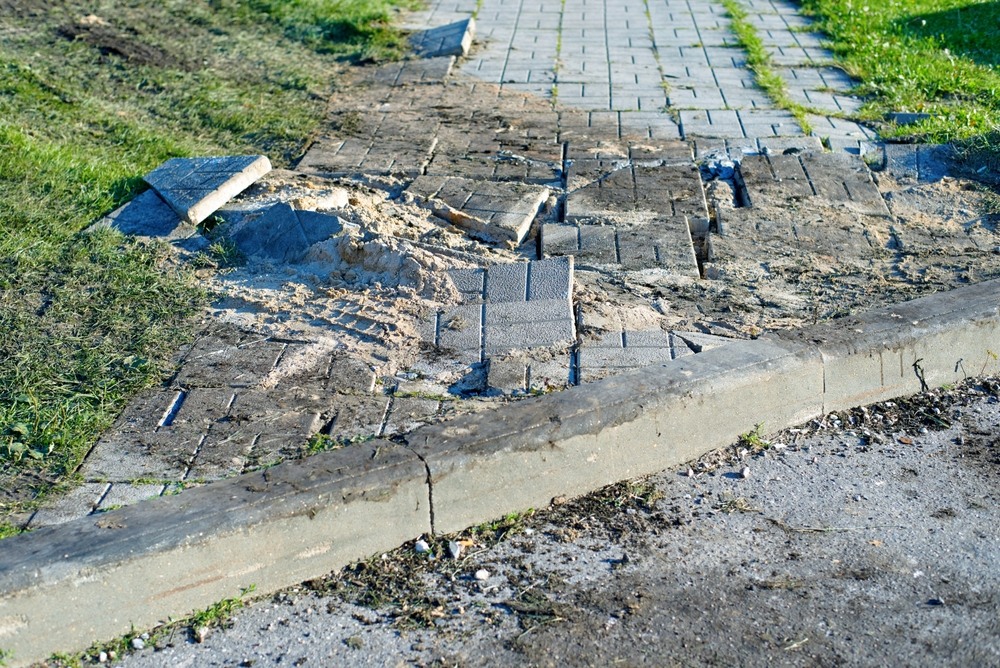 Evidence in sidewalk cases decays fast because property owners repair the defect quickly once someone reports a fall. The strongest cases are built on photographs and measurements taken within the first 24 to 72 hours, before any patching happens.
Steps that protect an unsafe sidewalk injury claim include:
- Photograph the defect from multiple angles with a ruler, coin, or shoe placed alongside for scale.
- Measure the height differential between the raised and lowered edges of the defect.
- Photograph the surrounding area to show what type of property (commercial, residential, municipal) the sidewalk abuts.
- Get medical attention promptly and describe how the sidewalk slip and fall happened to every provider.
- Get the names and phone numbers of any witnesses before they leave.
- Save the shoes worn at the time of the fall in a bag, without cleaning them.
- Report the fall to the abutting property owner or business in writing, and to Newark 311 if the defect appears on a public sidewalk.
Documentation created the day of the fall carries far more weight than any recollection given weeks later at a deposition. Contemporaneous photographs and measurements defeat the defense argument that the defect was minor or unforeseeable.
What Damages May a Sidewalk Fall Victim Recover in NJ?
A person injured in a broken sidewalk fall may recover damages for medical expenses, lost income, pain and suffering, and future losses tied to the injury.
Recovery depends on liability, damages, insurance limits, comparative negligence, and the strength of the notice evidence against the responsible party.
Damages against a commercial property owner or the City of Newark often turn on the size of the liability policy in place and the severity of the injury.
What Injuries Can Lead to Significant Damages in a Sidewalk Fall Case?
Common injuries from unsafe sidewalk falls that produce meaningful damages claims include wrist and forearm fractures, hip fractures in older adults, head injuries from falling forward onto pavement, dental injuries, and shoulder tears from bracing the fall.
Serious cases often need orthopedic surgery, physical therapy, and long-term follow-up. Our office coordinates medical documentation through an established treating-doctor network across northern New Jersey, which matters when the claim rests on specialist care that goes beyond a single emergency room visit.
Intake handles English, Spanish, and Haitian Creole around the clock.
FAQs for Unsafe Sidewalk Injury Lawyer
Can I Sue My Neighbor if I Tripped on the Sidewalk in Front of Their House?
Not usually. New Jersey generally does not impose residential homeowner liability on single-family owners for natural sidewalk defects like tree root heaves or weather cracking.
Exceptions exist if the homeowner’s own conduct created the defect, or if the property has a commercial character. A local ordinance requiring homeowners to maintain sidewalks does not by itself create civil liability to an injured pedestrian.
How Long Do I Have to Sue After Tripping on a Broken Sidewalk?
You generally have two years from the date of the fall to file a personal injury lawsuit in New Jersey under N.J.S.A. 2A:14-2. That deadline shrinks to 90 days for a notice of claim if the sidewalk abuts public property. Missing either deadline typically ends the case regardless of injury severity.
What if I Cannot Remember Exactly Where I Fell?
You may still have a case, though the value depends on how quickly the location can be identified. Nearby witnesses, medical records that describe the fall, phone location history, and photos from that day often let an attorney reconstruct the location.
Sidewalk cases rarely survive when the exact defect cannot be identified at all.
How Much Does an Unsafe Sidewalk Injury Lawyer Cost Up Front?
Nothing. Our firm handles sidewalk injury claims on a contingency basis, meaning no recovery, no fee. Our office advances the case costs (measurement experts, records requests, deposition transcripts, filing fees) and recoups them only from a settlement or verdict.
Does the Defect Have to Be a Certain Height for Me to Have a Case?
No. New Jersey does not apply a bright-line inch rule for actionable sidewalk defects. Height matters, but so do the location, the lighting, foot traffic patterns, the property owner’s notice of the defect, and the nature of the injury.
A modest defect in a heavily used commercial entrance is treated differently from the same defect on a low-traffic residential block.
Find Out Who Actually Owes You Before You Write the Case Off

Richard Goldstein, Premises Liability Attorney
The people who lose sidewalk injury claims in New Jersey usually lose them for the same reason: they went after the wrong defendant, gave up when that defendant said no, and never checked whether the property was actually classified as commercial or municipal.
The commercial-versus-residential distinction is a legal rule, not a matter of appearance, and the classification often surprises people who thought they knew the block.
Reach the team at Goldstein & Goldstein, LLP through our contact form and we will pull the tax records, check the property classification, run the 311 complaint history, and give you a straight read on whether a viable defendant exists.
Intake handles English, Spanish, and Haitian Creole around the clock.
Our East Orange Office
60 Evergreen Place
Suite 502
East Orange, NJ 07018
