

Our Family Has Given A Voice To The Injured For Over 50 Combined Years
Stairway Fall Lawyer in Newark
Stairway fall claims carry something most premises injury cases lack: an actual specification a jury may hold the property owner to. New Jersey’s Uniform Construction Code sets exact numbers for riser height, tread depth, and handrail height.
When a stair violates an applicable code requirement and that violation contributes to a fall, the injured person may have objective evidence supporting a negligence claim.
A stairway fall lawyer builds the case around those specifications, the notice evidence showing the landlord knew about the defect, and the medical documentation tying the fall to the violation.
Our team at Goldstein & Goldstein, LLP represents people injured on defective stairways across Newark, East Orange, Irvington, the Ironbound, and the broader Essex County market. Reach us through our contact form for a private review.
Why Are Stairway Cases More Provable Than Other Slip and Fall Claims?
Stairway fall cases can be easier to prove because they often involve measurable defects and specific building code requirements. Riser height, tread depth, handrail height, and other stair features can be compared directly against the standards that applied to the property.
New Jersey has adopted the International Building Code and International Residential Code through the New Jersey Uniform Construction Code, N.J.A.C. 5:23.
When a stairway violates an applicable code requirement and that violation contributes to a fall, the violation may provide objective evidence supporting a negligence claim.
Our office focuses on two key parts of that analysis: documenting the stairway before it changes and identifying the code requirements that applied when the stairs were built or altered.
Coordinated Measurement Experts
 Physical measurement of the stairway within days of the fall creates the record that carries the case forward.
Our office coordinates measurement work with building code experts who document riser heights across every step, tread depths, handrail height, handrail continuity, and the presence or absence of graspable handrails on both sides where required.
The measurements are what let a jury compare the actual stair to the code minimum.
Long-Standing Practice in Essex County Housing Cases
Goldstein & Goldstein, LLP has represented Essex County injury clients since 1997. Our four attorneys carry more than 50 combined years of trial and litigation work in New Jersey courts.
Michael J. Goldstein holds the New Jersey Supreme Court Certified Civil Trial Attorney designation. Representative firm results include $1.1 million, $825,000, $800,000, $695,000, and $609,000.
Past results do not predict any specific outcome. Our client rating is 4.7 stars across 316 Google reviews, with intake in English, Spanish, and Haitian Creole, 24 hours a day.
What Does New Jersey Building Code Require for Stairs?
New Jersey’s building code sets specific dimensions for stairs and handrails, and the requirements differ between commercial and residential occupancies.
Commercial buildings and multi-family residential buildings of three or more units fall under the International Building Code as adopted by the New Jersey Uniform Construction Code.
One- and two-family homes fall under the International Residential Code as adopted by the same code. The core requirements our office measures against include the following.
| Feature | Commercial / Multi-Family (IBC) | One or Two-Family Home (IRC) |
|---|---|---|
| Maximum riser height | 7 inches | 7 ¾ inches |
| Minimum tread depth | 11 inches | 10 inches |
| Maximum variation between risers in the same flight | 3/8 inch | 3/8 inch |
| Handrail height above nosing | 34 to 38 inches | 34 to 38 inches |
| Handrails | Generally required on both sides, subject to exceptions | Generally required on at least one side when required by the applicable code |
| Handrail continuity | Generally required through the flight | Generally required through the flight |
A stair with risers that vary more than the allowed tolerance is one of the most common code violations that produce falls in Newark’s older housing stock.
A tenant who catches a foot on a single riser that is a full inch taller than the others has a stronger case than the fall pattern suggests, because the code tolerance rule is objective and easy to prove.
What Are the Most Common Stair Defects That Cause Falls in Newark?
 The most common stair defects our office sees in Newark multi-family housing involve handrails, tread wear, lighting, and non-uniform riser heights left over from decades of piecemeal repair.
Each of these defects tends to map to a specific code section, which is what makes them provable in litigation.
Missing or Loose Handrails
Missing handrails or handrails that pull away from the wall on load are the single most common defect in stair injury cases. The building code requires handrails capable of resisting 200 pounds of force applied in any direction.
A handrail that pulls away from the wall under load may violate applicable code requirements and may be evidence that the defective handrail contributed to the fall.
Non-Uniform Riser Heights
Non-uniform riser heights are a legacy defect in Newark’s older walk-ups, often caused by decades of patched flooring or replaced treads.
The code allows only 3/8 of an inch of variation between the tallest and shortest riser in a single flight. Anything beyond that catches feet on the way down and creates a foreseeable fall hazard.
Inadequate Stairwell Lighting
Inadequate lighting in interior stairwells is a violation of both building code and multiple-dwelling law requirements for common area illumination.
Burned-out bulbs, broken fixtures, and windows painted over during renovations all reduce the light needed for safe passage. Lighting defects often combine with another physical defect to produce the fall.
Worn, Chipped, or Loose Treads
Worn stair treads that have lost their nosing or slip resistance produce falls even when the underlying dimensions meet code.
Chipped stone treads on exterior stairs and cupped wooden treads on interior flights are frequent contributors to falls in older Newark buildings. Damaged flooring and loose treads that shift under weight fall into the same category.
Missing or Non-Compliant Guards
Missing guards on open stair sides create fall-over-the-edge hazards distinct froml trip-and-fall on the stair itself. Guards must generally be at least 42 inches high in commercial and multi-family buildings, with baluster spacing that will not allow a 4-inch sphere through.
Failure to install compliant guards on a raised stair landing produces some of the most serious injuries in this practice area.
What Duty Does a Landlord Have for Stairs in Common Areas?
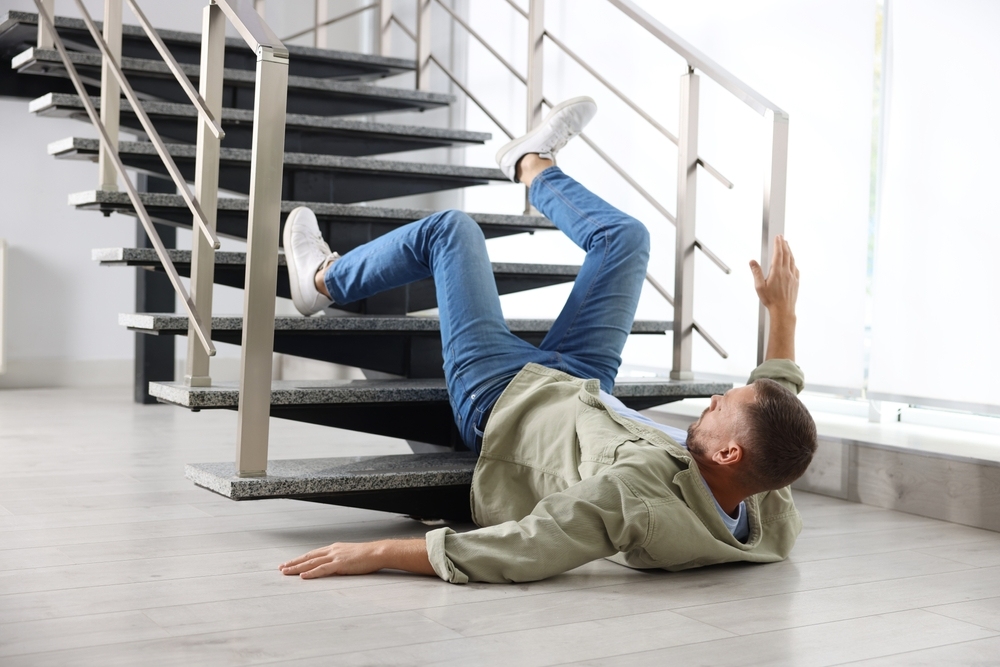 Landlords in New Jersey owe a duty of reasonable care to maintain common areas of multi-family buildings in reasonably safe condition, and stairs, along with building elevators, almost always fall within common-area control.
That duty comes from Michaels v. Brookchester, Inc., 26 N.J. 379 (1958), and later cases confirming that the landlord retains control of the shared stairs, hallways, and entryways in multi-family buildings.
Failure to maintain those areas in reasonable condition supports a premises liability claim when a tenant, guest, or visitor is injured as a result.
Notice is the second element the landlord’s insurer will contest hardest.
When the landlord did not create the defect, the injured person may need to show that the landlord knew or reasonably should have known about it before the fall.
Evidence that establishes notice in stair cases includes:
- Written maintenance requests from tenants about the specific defect
- Prior 311 or code enforcement complaints against the building
- Housing inspection reports issued under the New Jersey Hotel and Multiple Dwelling Law, N.J.S.A. 55:13A
- Prior injury reports at the same stairwell
- Photographs from Google Street View or building marketing materials showing the defect existed months earlier
Newark’s Division of Housing Code Enforcement conducts regular inspections of multi-family properties under state law.
Those inspection records may show that the same defect was cited before the fall, which can provide strong evidence that the landlord had notice of the condition.
What Evidence Should You Preserve After a Stairway Fall?
Evidence in stairway cases decays fast because landlords typically repair the defect within days once someone is injured.
Photographs, measurements, and witness statements gathered soon after the fall can preserve important evidence before the stairway is repaired or changed.
Steps that protect a stair fall injury claim include:
- Photograph every step of the flight from top to bottom, along with the handrail and any missing hardware.
- Measure or photograph a ruler against the defect (riser height, handrail height, gap width).
- Photograph the lighting conditions in the stairwell at the same time of day as the fall.
- Save any part of the stair or handrail that broke off during the fall.
- Get names and phone numbers of any neighbors who saw the fall or knew about the defect.
- Report the fall to the landlord or building manager in writing (email or certified mail).
- Request that the landlord preserve any surveillance video covering the stairwell entrance.
Physical evidence documented the day of the fall carries far more weight than photographs taken after the landlord has replaced the handrail. A stair case built on a rebuilt stairwell often relies entirely on witness memory, which is the weakest evidence of all.
What Damages May a Stairway Fall Victim Recover in NJ?
A person injured in a stairway fall may recover damages for medical expenses, lost income, pain and suffering, and future losses caused by the injury.
Recovery depends on the severity of the injury, the strength of the code and notice evidence, and the liability coverage the landlord maintains.
Falls from stairs often produce more serious injuries than ground-level falls because the person continues to travel downward through additional steps before stopping.
The damages in a stairway fall case often depend on the type and severity of the injuries.
Head and Traumatic Brain Injuries
Head impacts on stair edges and landings can cause concussions, skull fractures, and traumatic brain injuries. Damages in these cases account for emergency care, neurological follow-up, cognitive testing, and any long-term effects on work or daily function.
Spinal and Neck Injuries
Falls down a full flight of stairs generate compression forces on the neck and spine that produce herniated discs, vertebral fractures, and in serious cases, spinal cord injuries. These cases often need MRI imaging, epidural injections, and sometimes surgical intervention.
Fractures of the Wrist, Arm, Hip, and Ankle
Fractures to the wrist and forearm are common when the injured person braces forward. Hip fractures happen in falls where the person lands on the side, and ankle fractures happen when the foot catches on a defective tread.
Recovery may involve surgical fixation, extended physical therapy, and permanent loss of range of motion.
Facial and Dental Injuries
Face-first stair falls produce dental fractures, lost teeth, and facial lacerations that may leave visible scarring. Dental reconstruction is expensive and often extends over many months, which is captured in the damages calculation.
Our office coordinates medical documentation through an established treating-doctor network across northern New Jersey. That coordination matters when the injury pattern is serious enough that specialist care must extend well beyond a single emergency room visit.
FAQs for Stairway Fall Lawyers
How Long Do I Have to Sue a Landlord After a Stairway Fall in NJ?
You generally have two years from the date of the fall to file a personal injury lawsuit under N.J.S.A. 2A:14-2.
That window shrinks to 90 days for a formal notice of claim if the building is publicly owned (for example, a Newark Housing Authority property) under the New Jersey Tort Claims Act. Missing either deadline typically ends the case.
Do I Still Have a Case if the Stairs Were Built Before Modern Code?
Possibly. New Jersey applies current building code standards to new construction and major renovations, and older stairs may be lawfully “grandfathered” at their original specifications.
That grandfathering does not eliminate the landlord’s general duty of care, so a stair that meets its original code but has fallen into disrepair (loose handrail, worn treads, poor lighting) may still support a claim.
Can I Sue if I Was Carrying Something When I Fell Down the Stairs?
Yes, though the defense may raise it. New Jersey follows modified comparative negligence, which allows recovery as long as the injured person is 50 percent or less at fault.
Carrying groceries, laundry, or a child does not automatically bar the claim if a code violation or defective condition caused the fall.
How Much Does a Stairway Fall Lawyer Cost Up Front?
There is no upfront fee. Our firm handles stairway injury claims on a contingency basis, which means we only collect an attorney fee if we recover compensation for you.
We also advance case expenses, such as expert fees, records requests, deposition costs, and filing fees, and recover those costs from any settlement or verdict.
What if the Handrail Was There but Broke Off in My Hand?
You may have a strong claim. A handrail that fails under load may violate applicable building code requirements and can provide strong evidence that the stairway was not safely maintained.
Preserve the broken hardware if possible, along with any pieces that came off the wall.
Have the Stairs Measured Before the Landlord Fixes Them

Richard Goldstein, Premises Liability Attorney
Measurements and photographs taken before a stairway is repaired can be critical evidence in a Newark stairway fall claim. They can show the exact riser height, tread depth, handrail condition, lighting, and other defects that may have contributed to the fall.
Once repairs are made, it can become much harder to prove what the stairway looked like on the day of the injury. Early documentation also gives a building code expert something concrete to compare against the standards that applied to the property.
Goldstein & Goldstein, LLP investigates stairway fall claims across Newark and Essex County. Our team can send preservation letters, coordinate on-site measurements with building code experts, and review inspection and maintenance records for evidence of prior problems.
Reach us through our contact form for a private case review. Intake is available in English, Spanish, and Haitian Creole 24 hours a day.
Our East Orange Office
60 Evergreen Place
Suite 502
East Orange, NJ 07018
