

Our Family Has Given A Voice To The Injured For Over 50 Combined Years
Newark Bicycle Accident Lawyers
Cyclists in Newark share the road with drivers who treat them as intruders. New Jersey law treats them as vehicles. Under N.J.S.A. 39:4-14.1, every person riding a bicycle on a roadway is granted all the rights and is subject to all the duties that apply to the driver of a vehicle.
That framing matters when a Newark bicycle accident lawyer builds the case, because it undercuts the reflexive assumption that a cyclist was where they should not have been.
The right to be there is only the starting point. The harder work is figuring out which insurance pays first and which liability rules apply.
It also matters whether the bike is a traditional bicycle, a low-speed electric bicycle, or a vehicle New Jersey now treats as motorized after the 2026 e-bike overhaul.
How We Approach a Newark Bicycle Case at Our East Orange Office
Our office in East Orange takes bike cases from across the Newark corridor and greater Essex County, and the intake work tends to look different than a standard auto claim.
On day one, we identify the primary PIP carrier under the New Jersey no-fault statute, put the driver’s insurer on notice, and confirm what type of bicycle was involved so the coverage analysis matches current NJ law.
Richard Goldstein founded the practice in 1997 and now works alongside his son, Michael J. Goldstein. Michael is a New Jersey Supreme Court Certified Civil Trial Attorney, a designation held by a small percentage of civil attorneys in the state.
Cyclist injuries often skew orthopedic and neurological, and continuity of care matters when PIP limits are low. Our established doctor network is part of how we support clients while the liability side of the case develops.
Case reviews are available in English, Spanish, and Haitian Creole, on a contingency basis, with costs advanced by our office.
What Rules of the Road Apply to Newark Cyclists and the Drivers Around Them?
 New Jersey road rules give cyclists the same standing as drivers and impose specific duties on drivers who pass them. Under NJSA 39:4-14.1, a cyclist has the rights and responsibilities of a motor vehicle operator on the roadway.
Under the New Jersey Safe Passing Law, drivers approaching a cyclist or other vulnerable road user must move over, allow a buffer, or slow down and prepare to stop.
The practical rules that come up most often in Newark bicycle accident claims include:
- The requirement that drivers stop and remain stopped for pedestrians in crosswalks, which also protects cyclists dismounting to cross
- The Safe Passing Law’s requirement that drivers change lanes or leave at least four feet of buffer when passing a cyclist
- The cyclist’s obligation to ride as near to the right roadside as practicable under N.J.S.A. 39:4-14.2, with several exceptions
- The cyclist’s right to move left to avoid road hazards, turn, or pass a slower vehicle
- Local ordinances layered on top of state law, which vary across Newark, East Orange, Irvington, and Bloomfield
Traffic-stop paperwork often misses these details. Getting them into the record early tends to shift how the insurance carrier frames fault.
What Is a Dooring Accident and Who Is Usually Liable?
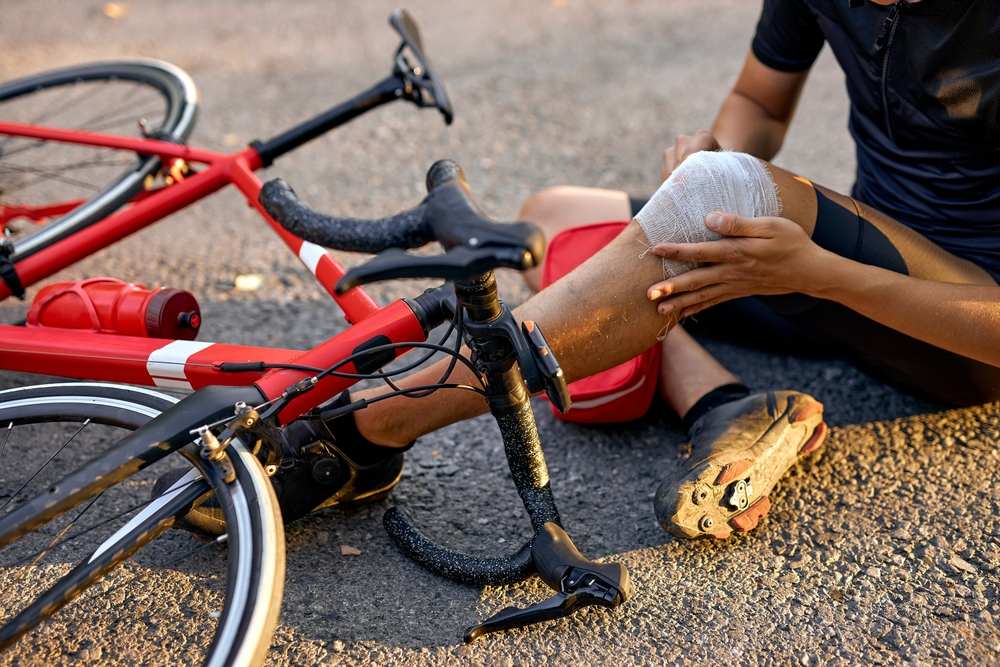 A dooring accident happens when a driver or passenger opens a car door into the path of a cyclist.
Liability in these cases usually rests with the person who opened the door, because NJ places a duty on vehicle occupants not to open a door into moving traffic without first taking reasonable care to check for oncoming users.
Dooring claims come up often on Newark corridors with curbside parking and active bike traffic, including Broad Street, Market Street, and Ferry Street through the Ironbound. Common features of these cases include:
- Impact at low cyclist speeds combined with sudden immovable obstruction
- Head, shoulder, and clavicle injuries from being thrown forward or sideways
- Independent liability of a passenger who opened the door, not just the driver
- Rideshare, such as Uber or Lyft, and delivery scenarios where the door-opener is a passenger of a for-hire driver
- Coverage disputes when the parked vehicle’s insurer initially denies involvement in a moving-traffic crash
The insurance framing on a dooring case is often the fight. The physics are straightforward. Getting the correct carrier to accept the claim usually is not.
How Does NJ’s E-Bike and Scooter Law Change the Analysis?
New Jersey overhauled its e-bike law in 2026, replacing the prior three-class system with new statutory categories that carry different licensing, registration, and insurance requirements.
The NJ Motor Vehicle Commission began issuing the new registrations and licenses on June 26, 2026. The category a bike falls into affects which coverage responds after a crash and whether the rider had to carry insurance in the first place.
The current framework groups electric bikes and scooters into distinct categories under NJ law:
| Category | General Description | Registration | Insurance Required |
|---|---|---|---|
| Low-speed electric bicycle | Pedal-assist only, motor assistance ends at 20 mph | Required | Not required |
| Motorized bicycle | Includes qualifying throttle-capable and pedal-assist configurations up to 28 mph | Required | Required |
| Low-speed electric scooter | Separate statutorily defined stand-up device | Follows scooter-specific rules | Separate analysis |
The table is a general reference to the current NJ framework. Rules continue to evolve, and any specific case should be evaluated against the classification of the exact bike or scooter involved.
Coverage sits on top of the category. A traditional cyclist or a low-speed e-bike rider generally looks to their own or a household auto policy for PIP after being struck by a car.
A motorized bicycle rider carries required insurance that changes the coverage stack. These distinctions matter early, because opening the wrong file wastes time the claim does not have.
How Does PIP Apply When a Cyclist Is Struck by a Car in New Jersey?
Personal Injury Protection, known as PIP, is the no-fault medical coverage every New Jersey auto policy must carry under N.J.S.A. 39:6A-4.
 A person riding a traditional bicycle is treated as a pedestrian for NJ automobile PIP purposes, and the 2026 e-bike legislation extends that treatment to a person operating a low-speed electric bicycle.
For a traditional cyclist or a qualifying low-speed e-bike rider hurt in a car accident, applicable PIP may come through the rider’s own auto policy or qualifying household coverage. If no applicable PIP coverage exists, statutory benefits through New Jersey’s fund system may be available to qualifying claimants.
How Does PIP Coverage Differ for Motorized Bicycles?
Motorized bicycles sit in a different place. Because a motorized bicycle now carries required insurance under NJ law, the coverage analysis after a crash starts with the rider’s own policy on that vehicle rather than a household auto policy. Getting the classification right is the first move in either scenario.
Standard NJ auto policies default to $250,000 in PIP, but many drivers select limits as low as $15,000. Serious cyclist injuries frequently exhaust a low PIP limit within weeks, which pushes unpaid balances into the liability claim against the at-fault driver.
That transition point is where a lot of these cases quietly stall without counsel.
Does the NJ Helmet Law Bar Recovery for Adult Cyclists?
The NJ helmet law does not bar recovery for adult cyclists hurt in a crash. Under N.J.S.A. 39:4-10.1, riders and passengers under 17 years of age must wear an approved helmet on a bicycle.
The statute imposes an equipment requirement on minors and does not create a legal defense that eliminates an adult cyclist’s claim for compensation.
For minors, non-use of a helmet may enter the case as one factor in the fault analysis, but it does not automatically end the claim.
The larger question in most bike-versus-car crashes remains the driver’s conduct and whether the driver met the duties NJ law imposes on vehicles sharing the road with cyclists.
What Evidence and Damages Matter Most in a Bicycle Accident Claim?
Evidence in a bicycle crash case tends to disappear quickly, and the damages picture tends to grow slowly. Both trends work against a cyclist who waits.
Video and physical evidence at the scene often turn over within days, while the true medical picture may not stabilize for months.
Early evidence priorities in these cases include:
- Preservation letters to nearby businesses and property owners to hold surveillance video
- Photos of the bicycle, the vehicle, the roadway markings, and any door-zone geometry
- Copies of the crash report and any accompanying investigation notes
- Names and contact information for every witness identified at the scene
- Written notice to the applicable auto carrier to open a PIP file promptly
Cyclist injuries often include fractures of the collarbone, wrist, and lower extremities, along with head injuries and road-rash trauma that leaves lasting scarring.
Damages in a Newark bicycle accident lawyer case may include medical bills that exceed PIP, future care, lost wages, reduced future earning capacity, pain and suffering, and, in appropriate cases, damages for permanent injury or disfigurement.
Whether pain-and-suffering damages face the verbal-threshold limitation under N.J.S.A. 39:6A-8
depends on the tort option selected on the applicable auto policy. That analysis belongs in the intake conversation, not at the end of the case.
FAQs for Newark Bicycle Accident Lawyer Cases
Who pays my medical bills if I was hit by a car while biking in Newark?
Your own New Jersey auto insurance policy generally pays your medical bills first under the state’s no-fault law, even when you were on a bicycle. If you do not own a car, a resident relative’s NJ auto policy may cover you.
The at-fault driver’s insurance usually does not pay the medical bills directly, though a liability claim against that driver is a separate matter.
Do I have a case against the driver if I was not wearing a helmet?
Yes for adults, and often yes for minors. New Jersey’s helmet law under NJSA 39:4-10.1 applies to riders under 17, and it does not bar an adult cyclist from recovering for a crash caused by a driver.
For minors, non-use of a helmet may enter the fault analysis, but it usually does not eliminate the claim.
Can I sue the driver who doored me on Broad Street or Ferry Street?
Yes, dooring cases are viable civil claims in New Jersey. The person who opened the door owes a duty of reasonable care to check for approaching cyclists and other road users before opening into moving traffic.
That duty applies to drivers and passengers alike, which sometimes matters in rideshare and delivery scenarios.
Do the new NJ e-bike rules affect my crash claim?
Yes, the 2026 changes to NJ e-bike law may affect which insurance responds to your crash. The state replaced the older three-class framework with new statutory categories that carry different licensing, registration, and insurance requirements.
Identifying the correct category for the bike involved is often the first step in a coverage analysis.
How long do I have to file a bicycle accident lawsuit in New Jersey?
The general personal injury statute of limitations in New Jersey is two years from the date of injury under N.J.S.A. 2A:14-2.
Shorter deadlines apply when the defendant is a public entity, such as a NJ Transit vehicle or a municipal driver, which is governed by the Tort Claims Act and its notice rules.
What if the driver said I came out of nowhere?
That claim is common and rarely accurate. Cyclist visibility is often better than drivers report, and NJ law places specific duties on drivers to look for and yield to vulnerable road users.
Independent witness accounts, video, and reconstruction of sightlines usually paint a different picture than a driver’s post-crash statement.
Get the Coverage Question Answered Before the Bike Bill Arrives

Richard Goldstein, Bicycle Accident Attorney
The single most useful move after a bicycle crash in New Jersey is figuring out which insurance policy is supposed to pay first and identifying the current NJ category for the bike involved.
Both answers set the shape of the case. Both are set by statute, not by the phone number stapled to the discharge paperwork.
Our office in East Orange handles bicycle cases across the Newark corridor and greater Essex County. Bring us the crash report, discharge paperwork, photos of the bike and the vehicle, and the declarations pages of every auto policy in your household.
From there, we identify the primary PIP carrier, place the driver’s insurer on notice, evaluate the current NJ classification of the bike, and lay out the path forward.
A case review is available in English, Spanish, or Haitian Creole through our contact page, on a contingency basis, with costs advanced by our office.
Our East Orange Office
60 Evergreen Place
Suite 502
East Orange, NJ 07018
