

Our Family Has Given A Voice To The Injured For Over 50 Combined Years
Newark Parking Lot Slip and Fall Lawyers
Most people who fall in a parking lot assume the answer to “who do I sue” is the store they were walking into. That answer is right some of the time.
Often, it is the property owner, the management company running the lot, a snow removal contractor working under a service agreement, or a municipality that owns the lot outright.
Sorting out the defendant list is the single most important thing a parking lot slip and fall lawyer does in the first two weeks of a case.
Our team at Goldstein & Goldstein, LLP represents people injured in parking lots across Newark, East Orange, Irvington, the Ironbound, and the surrounding Essex County market. Reach us through our contact form for a private review of what happened.
How Our Team Handles the Multi-Party Investigation
Parking lot slip and fall cases live or die on the investigation done in the first two to three weeks, and that investigation looks nothing like the standard slip-and-fall workup inside a store.
A store fall may involve a single defendant. A parking lot fall often involves several potentially responsible parties.
 Our office investigates those relationships early by requesting records from the property owner, tenant, management company, and snow removal contractor at the same time, before accounts of what happened begin to diverge.
That coordinated approach is why parking lot claims benefit from a firm structured for the work:
- Same-week preservation letters go out to every custodian of video, incident reports, and snow-service logs.
- Cross-referenced service contracts identify which party promised to inspect, salt, patch, or repair.
- Coordinated medical documentation through our established treating-doctor network across northern New Jersey, which matters when orthopedic injuries from these falls need imaging beyond a single emergency room visit.
Goldstein & Goldstein, LLP has represented Essex County injury clients since 1997. Our four attorneys carry more than 50 combined years of trial and litigation work in New Jersey.
Michael J. Goldstein holds the New Jersey Supreme Court Certified Civil Trial Attorney designation. Representative firm results include $1.1 million, $825,000, $800,000, $695,000, and $609,000.
Past results do not predict any specific outcome. Our client rating is 4.7 stars across 316 Google reviews, with intake in English, Spanish, and Haitian Creole, 24 hours a day.
Who Is Actually Liable in a Parking Lot Slip and Fall?
Liability in a parking lot slip and fall case may fall on the property owner, the business tenant, the parking lot management company, a snow or maintenance contractor, or a public entity that owns the lot.
Which of those parties (or which combination) is responsible depends on the lease, the service contracts, and who created the hazard. New Jersey premises liability law generally holds each party responsible for what it controlled.
Sorting through the possibilities in the first weeks of a case usually involves records requests to multiple parties:
| Potential Defendant | When They May Be Liable |
|---|---|
| Property owner | Owns the lot and did not delegate maintenance, or delegated it improperly |
| Business tenant (store, restaurant) | Lease assigns lot maintenance to the tenant |
| Parking lot management company | Contract with owner covers inspections, cleaning, and repairs |
| Snow and ice removal contractor | Service agreement covers the date and location of the fall |
| Municipality (public lot) | The lot is owned or maintained by the city or county |
| General contractor / construction crew | Active work created the hazard (loose debris, open trench, uncovered cable) |
Multiple defendants often appear on the same complaint. A parking lot fall outside a Newark supermarket may result in claims against the supermarket, the shopping center owner, the property management company, and the snow removal contractor all at once.
Sorting who bears what share of fault happens later, through discovery and expert review.
How Does the Ongoing Storm Rule Affect a New Jersey Parking Lot Fall?
 New Jersey’s ongoing storm rule generally protects commercial property owners from liability for snow and ice injuries that happen during an active storm or within a reasonable time after it ends.
The New Jersey Supreme Court set that rule in Pareja v. Princeton International Properties in 2021. The rule is not absolute, and several situations still support a claim even during winter weather.
Situations where a parking lot slip and fall claim on ice or snow may still move forward include:
- The fall happened well after the storm ended and the owner had a reasonable window to clear the lot.
- Ice formed from a pre-existing drainage problem or a broken gutter unrelated to the current storm.
- The property owner or snow contractor took action that affirmatively increased the danger, which is the exception recognized in Pareja.
- The hazard existed before the storm began.
- A snow contractor plowed in a way that piled snow where it melted and refroze in a pedestrian path.
Newark winters produce mixed precipitation patterns that create refreeze conditions long after the storm has passed. That timing gap is often where the strongest claims live.
Why Does Surveillance Footage Matter So Much in Parking Lot Claims?
 Surveillance footage of the fall itself is usually the single most valuable piece of evidence in a parking lot slip and fall case, and most lot systems overwrite recordings on a short cycle.
Retention periods commonly range from 7 to 30 days, though some larger operators keep footage 60 to 90 days. Without a formal preservation letter, that footage typically vanishes into automatic overwrite.
What the video captures often decides the case. Beyond showing the fall, footage may capture:
- The exact hazard (puddle, ice patch, pothole, spilled liquid) that caused the fall
- How long the hazard was present before the fall, which supports the notice element of the claim
- Whether store or maintenance staff walked past the hazard without addressing it
- Weather and lighting conditions at the exact moment
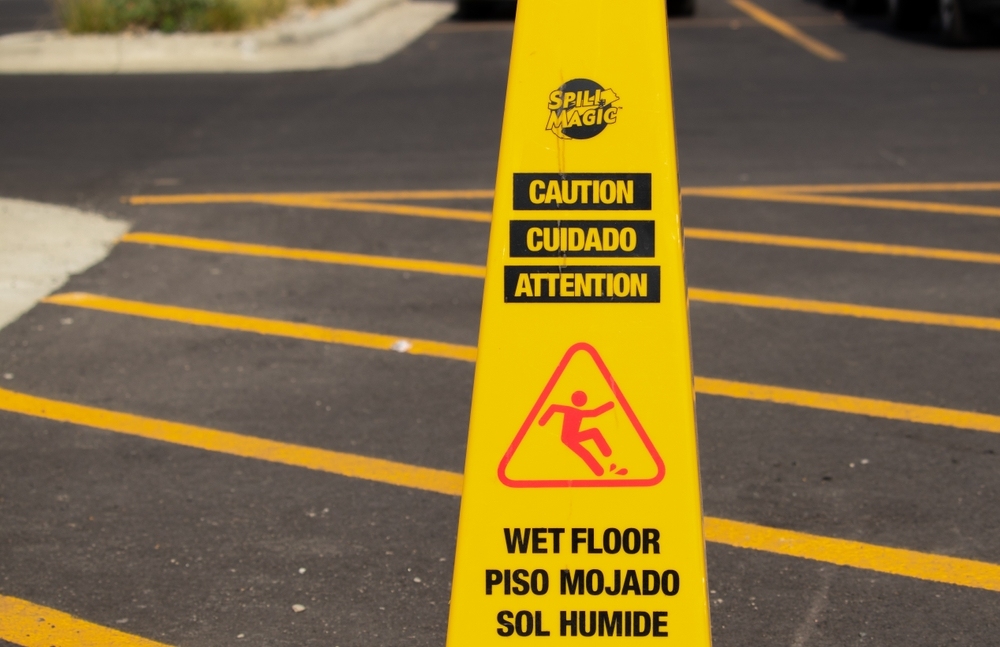
- The absence of warning cones or “Wet Floor” signs
- Prior falls or near-falls in the same spot on the same day
An attorney engaged within days of the fall may send a spoliation letter to every potential custodian of video, which triggers a legal duty to preserve.
Attorneys engaged after 30 days often arrive to find the footage gone, and the case then rests on witness memory and physical evidence alone.
What Evidence Should You Preserve After a Parking Lot Fall?
Preserving evidence after a parking lot fall means documenting the hazard, the scene, and your injuries before anything gets cleaned, repaired, or overwritten. The strongest premises liability claims are built from evidence gathered in the first 48 to 72 hours, when the scene still reflects what caused the fall.
Steps that help a parking lot slip and fall lawyer build the claim include:
- Photograph the exact hazard from multiple angles with a reference object for scale.
- Photograph the surrounding lot, including any missing warning cones, drainage patterns, and lighting.
- Get the names and phone numbers of any witnesses before they leave the scene.
- Report the fall to the store manager or lot attendant and ask for a copy of the incident report.
- Keep the shoes and clothing worn at the time in a bag, without washing them.
- Save the receipt or timestamped record showing you were on the property that day.
- Follow up in writing to request preservation of surveillance footage.
Physical evidence tells a story that memory alone cannot. Photographs of a pothole taken the day of the fall carry far more weight than photographs taken two weeks later after the lot has been repaved.
What if You Fell in a Public or Municipal Parking Lot in Newark?
Falls in public parking lots (owned by the City of Newark, Essex County, NJ Transit, or another public entity) trigger a strict 90-day notice requirement under the New Jersey Tort Claims Act, N.J.S.A. 59:8-8.
Missing that 90-day window generally bars the claim, even though the underlying two-year statute of limitations under N.J.S.A. 2A:14-2 has not yet run.
Public and quasi-public lots in the Newark area where this notice rule commonly applies include:
- Newark Municipal Council parking facilities
- Essex County-owned garages and lots
- NJ Transit park-and-ride lots near Newark Broad Street and Newark Penn Stations
- Newark Board of Education lots
- Rutgers Newark, NJIT, and Essex County College lots
Public entities also enjoy immunities that private property owners do not. Under N.J.S.A. 59:4-2, an injured person suing over a dangerous condition on public property must show the public entity’s action or inaction in protecting against the condition was palpably unreasonable.
That heightened standard makes early legal review particularly important when the lot is publicly owned.
FAQs for Parking Lot Slip and Fall Lawyer
How Long Do I Have to Sue After a Parking Lot Fall in NJ?
You generally have two years from the date of the fall to file a personal injury lawsuit in New Jersey under N.J.S.A. 2A:14-2. That window shrinks to 90 days for a formal notice of claim if the parking lot is owned by a public entity. Missing either deadline typically ends the case regardless of the injury.
Do I Need a Lawyer if the Store Already Filed an Incident Report?
Generally yes. An incident report captures the store’s version of events, which may minimize the hazard or shift blame toward the customer. An attorney may obtain the full report, compare it to surveillance footage, and challenge inaccurate statements before they become locked into the record.
What if I Fell in a Parking Lot but Was Not a Customer?
You may still have a claim. New Jersey premises liability law protects business invitees, licensees, and in some circumstances trespassers, though the duty owed by the property owner varies with each status. A parking lot open to the public for business purposes generally owes visitors a duty to keep the lot reasonably safe.
How Much Does a Parking Lot Slip and Fall Lawyer Cost Up Front?
Nothing. Our firm handles slip and fall cases on a contingency basis, meaning no recovery, no fee. Our office advances the case costs (expert witnesses, deposition transcripts, records requests, filing fees) and recoups them only from any settlement or verdict.
Can I Still Sue if I Was Looking at My Phone When I Fell?
Possibly, though the defense will raise it. New Jersey follows modified comparative negligence, which allows recovery as long as the injured person is 50 percent or less at fault. Distraction may reduce the damages awarded, but it does not automatically bar the claim if the hazard was one the property owner had a duty to address.
Protect the Evidence: Talk With a Newark Parking Lot Slip and Fall Lawyer

Richard Goldstein, Parking Lot Slip and Fall Lawyer
The parking lot cases that hold their value tend to share one trait: someone got a preservation letter out to every video custodian and snow contractor before the retention clock ran out. That window is short, and it starts on the day of the fall, not the day you decide to hire a lawyer.
Our Newark parking lot slip and fall lawyers at Goldstein & Goldstein, LLP have handled premises liability claims for Essex County residents since 1997.
Reach our team through our secure contact form to request a private case review. Intake staff answer in English, Spanish, and Haitian Creole, around the clock.
Our East Orange Office
60 Evergreen Place
Suite 502
East Orange, NJ 07018
