

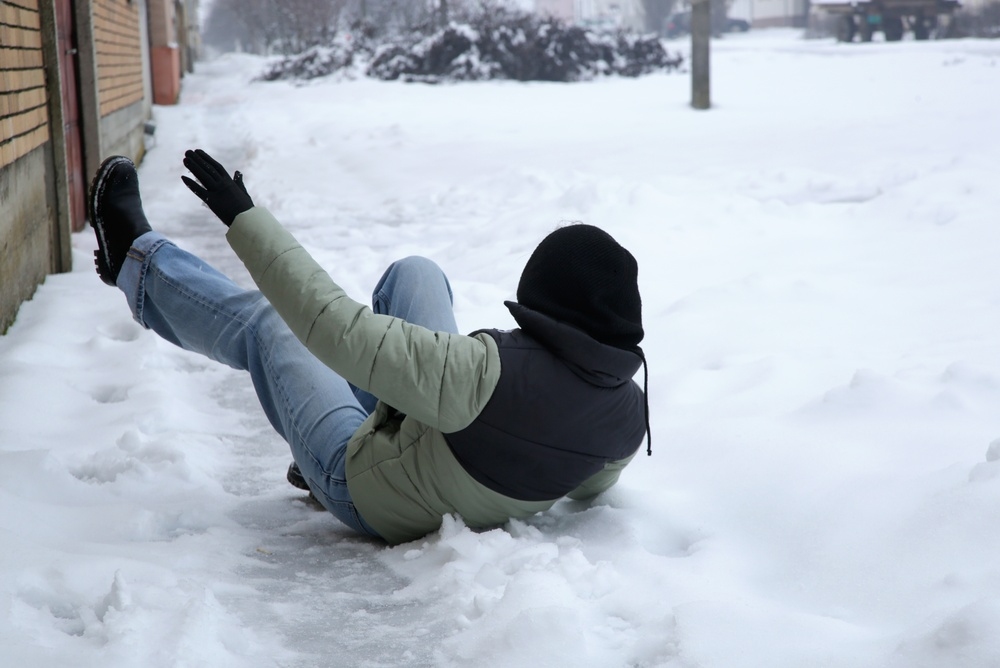
Our Family Has Given A Voice To The Injured For Over 50 Combined Years
Snow and Ice Removal Liability in NJ
Most people who slip on ice in New Jersey get told the same thing when they call the property’s insurance carrier: the storm rule. Adjusters lean on it heavily because it sounds airtight, and it is not.
Snow and ice removal liability in NJ has real exceptions built into the same case law the insurer is citing, and whether your fall fits inside those exceptions is a question worth asking a lawyer, not an adjuster.
Our team at Goldstein & Goldstein, LLP represents people injured in ice and snow falls across Newark, East Orange, Irvington, the Ironbound, and the surrounding Essex County market. Reach us through our contact form for a second read on what you were told.
What Is the New Jersey Ongoing Storm Rule?
The ongoing storm rule in New Jersey generally protects commercial property owners from liability for ice and snow injuries that happen during an active storm or within a reasonable time after it ends.
 The New Jersey Supreme Court adopted the rule in Pareja v. Princeton International Properties in 2021. The rule is not a blanket immunity. Several exceptions preserve a claim even when the fall happened during winter weather.
Fact patterns where a snow and ice fall claim may still move forward under Pareja include:
- The fall happened well after the storm ended and the property owner had a reasonable window to clear the walkway.
- The ice formed from a pre-existing condition, such as a broken gutter or drainage defect, unrelated to the current storm.
- The property owner or snow contractor took action that affirmatively increased the danger, which is the exception the Supreme Court recognized in Pareja.
- The hazard existed before the storm began.
- The fall happened on a surface the owner had already partially treated in a way that made the condition worse.
Newark winters produce mixed precipitation patterns that generate freeze-thaw cycles and overnight refreeze conditions long after the storm has passed. That timing gap between the end of the storm and the next morning’s commute is where the strongest claims often live.
Who Is Responsible for Sidewalk Ice in Newark?
Responsibility for sidewalk ice in New Jersey depends on whether the abutting property is commercial or residential.
Commercial property owners generally owe a duty to keep their abutting public sidewalks reasonably safe, established in Stewart v. 104 Wallace St., Inc., 87 N.J. 146 (1981).
Residential owners historically enjoyed broader protection under common law, though later case law has narrowed that protection in specific situations.
The duty picture changes with property type:
| Property Type | Sidewalk Duty |
|---|---|
| Commercial property | Generally owes a duty of reasonable care to abutting sidewalk users |
| Residential (owner-occupied, single-family) | Generally no common-law duty absent conduct that created or worsened the hazard |
| Multi-family residential | Duty may attach depending on the property’s commercial character |
| Mixed-use (storefront with apartments above) | Generally treated as commercial for sidewalk duty purposes |
| Public sidewalks abutting municipal property | Public entity duty under the Tort Claims Act, subject to statutory immunities |
| Vacant commercial property | Owner generally still owes commercial-property sidewalk duty |
Newark’s mixed neighborhood character produces sidewalk cases that turn on close analysis of the property. A storefront with second-floor apartments along Springfield Avenue reads as commercial. A single-family home two blocks over does not.
Our office pulls tax records, certificates of occupancy, and municipal designations early to lock the property classification down.
What Happens if You Fell on Ice at a Business or Parking Lot?
Falls on ice at commercial property (parking lots, entryways, walkways serving a store, restaurant, or office) generally support a snow and ice removal liability claim if the property owner had actual or constructive notice of the hazard and failed to act reasonably.
Commercial owners typically hire snow removal contractors, and the contractor may also be liable if the service agreement covered the date and location of the fall.
Two elements matter for a commercial ice fall claim:
- Notice. The owner or contractor must have known about the ice condition, or the condition must have existed long enough that they should have discovered it.
- Failure to act reasonably. Reasonable action depends on the type of property, weather forecast, availability of salt or sand, and industry standards for the location.
 Our firm has represented Newark and Essex County injury clients since 1997. Four attorneys carry more than 50 combined years of trial and litigation work in New Jersey. Michael J. Goldstein holds the New Jersey Supreme Court Certified Civil Trial Attorney designation.
Representative firm results include $1.1 million, $825,000, $800,000, $695,000, and $609,000. Past results do not predict any specific outcome.
Our client rating is 4.7 stars across 316 Google reviews, with intake in English, Spanish, and Haitian Creole, 24 hours a day.
Can You Sue a Snow Removal Contractor for Ice Injuries in NJ?
Snow removal contractors may be sued directly for ice and snow injuries in New Jersey if the contractor’s negligent work caused or worsened the condition.
The claim runs alongside any claim against the property owner, and both may appear on the same complaint. Getting the service contract is often the first step in evaluating whether a contractor claim belongs in the case.
The service agreement typically defines what the contractor promised to do and when.
Key questions our office asks about the contract include whether the contractor had a monitoring obligation between storms, whether salt or de-icing material was included, and whether the contractor was required to inspect before or after specific weather triggers.
A contractor who plowed a lot in a way that piled snow where it later melted and refroze in a pedestrian path may be liable for the refreeze injury.
What if You Slipped on Ice on a Public Sidewalk or in a Municipal Lot?
Ice falls on public sidewalks or in municipal parking lots owned by the City of Newark, Essex County, or another public entity trigger a strict 90-day notice requirement under the New Jersey Tort Claims Act, N.J.S.A. 59:8-8.
Missing that 90-day window generally bars the claim, even though the underlying two-year statute of limitations has not yet run. This deadline is the single most time-sensitive fact on this page.
Public and quasi-public property in Essex County where the 90-day notice rule commonly applies includes:
- Newark municipal sidewalks abutting city-owned buildings
- Essex County-owned parking facilities and courthouse walkways
- NJ Transit bus stops, train station platforms, and park-and-ride lots
- Newark Board of Education building walkways
- Rutgers Newark, NJIT, and Essex County College campus walks
Public entities also carry immunity protections that private owners do not.
Under N.J.S.A. 59:4-2, an injured person suing a public entity over a dangerous condition on public property must show the entity’s action or inaction in protecting against the condition was palpably unreasonable.
That heightened standard makes the 90-day notice deadline even more consequential, because it triggers the investigation window that produces the evidence needed to meet the standard.
What Evidence Should You Capture After a Snow or Ice Fall?
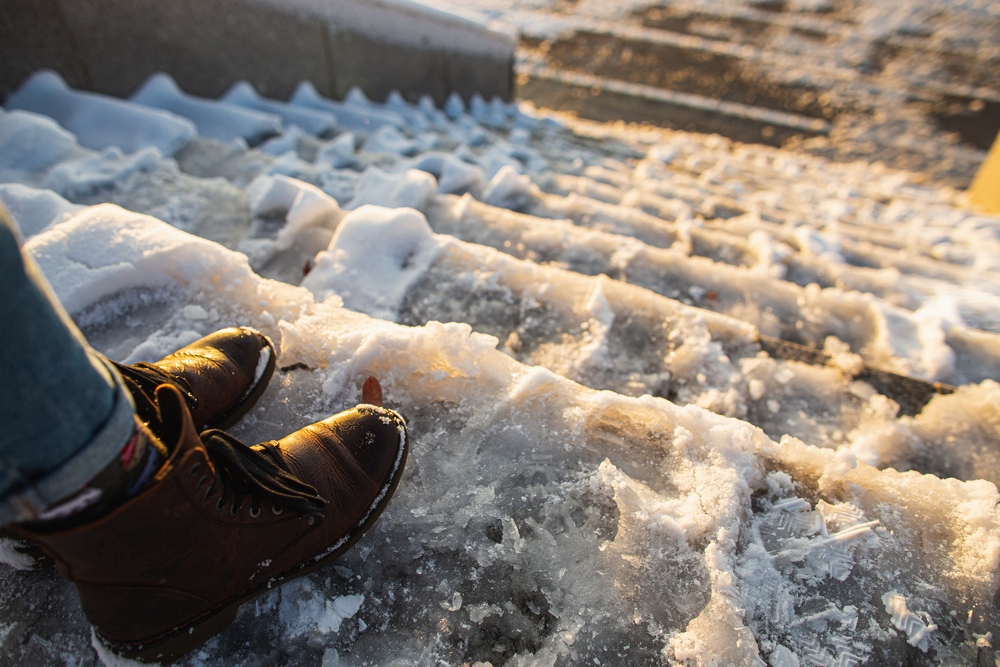 Evidence in a snow and ice case decays faster than in almost any other type of premises claim. Ice melts. Snow gets plowed. Salt gets thrown down after the fall to cover the exact spot that caused the injury.
The strongest cases are built on evidence gathered within the first 24 to 48 hours, before the scene stops looking anything like it did at the moment of the fall.
Steps that protect a snow and ice removal liability claim include:
- Photograph the exact spot of the fall from multiple angles, with a reference object for scale.
- Photograph the surrounding walkway, showing whether treatment (salt, sand, plowing) was applied to any nearby areas.
- Capture the weather at the moment through a phone screenshot of a weather app timestamped the day of the fall.
- Get the names and phone numbers of witnesses before they leave the location.
- Report the fall to the property owner, business manager, or building superintendent and ask for a written incident report.
- Keep the shoes worn at the time of the fall in a bag, without cleaning them.
- Save weather service records for the 24 to 72 hours before the fall, which document when the storm ended.
Contemporaneous documentation defeats the two arguments a defense lawyer relies on most: that the storm was still active, and that the ice was fresh and unforeseeable. Photographs and weather records taken the day of the fall lock down the timeline.
Can the Defense Argue You Wore the Wrong Shoes?
Yes, the defense may argue that footwear, walking pace, or route choice contributed to the fall, and New Jersey’s modified comparative negligence rule allows that argument to reduce damages.
A person 50 percent or less at fault may still recover, though the recovery is reduced by the person’s share of fault. Cross the 51 percent threshold and the claim is barred entirely.
Common comparative-fault arguments in snow and ice cases include claims that the injured person wore inappropriate footwear for the conditions, walked too quickly, ignored a warning sign or cone, or chose an untreated route instead of an available treated route.
These arguments rarely succeed on their own because they run against the fundamental duty rule: a property owner cannot use a customer’s footwear as a defense against failing to clear an obvious ice hazard. A jury usually reads that argument for what it is.
FAQs for Snow and Ice Removal Liability NJ
How Long After a Snow or Ice Fall Do I Have to Sue in NJ?
You generally have two years from the date of the fall to file a personal injury lawsuit in New Jersey under N.J.S.A. 2A:14-2. That window shrinks to 90 days for a notice of claim if the fall happened on public property. Missing either deadline typically ends the case regardless of how strong the underlying claim is.
Do I Still Have a Case if I Fell While It Was Still Snowing?
Maybe. New Jersey’s ongoing storm rule protects commercial property owners during an active storm, but exceptions apply.
If the fall happened after the storm ended, if a pre-existing condition caused the ice, or if the owner made the condition worse through its actions, the claim may still move forward.
A lawyer can review the weather record and the property owner’s conduct before writing off the case.
Can I Sue My Neighbor if I Fell on Their Sidewalk in Newark?
Not usually. New Jersey generally does not impose sidewalk-clearing liability on residential owners of single-family homes for injuries from natural accumulations.
Exceptions exist when the resident’s own conduct created or worsened the hazard, or when the property has a commercial character. A local ordinance requiring shoveling does not by itself create civil liability to an injured pedestrian.
How Much Does a Snow and Ice Injury Lawyer Cost Up Front?
Nothing. Our firm handles snow and ice injury claims on a contingency basis, meaning no recovery, no fee. Our office advances the case costs (expert witnesses, deposition transcripts, records requests, filing fees) and recoups them only from a settlement or verdict.
What if I Waited a Few Weeks to See a Doctor?
You may still have a case, though the delay creates a defense argument. Insurers routinely argue that any gap between the fall and the first medical visit signals the injury was minor or unrelated.
Documenting the pain and any home treatment during the gap helps close that argument. The claim itself remains viable if the medical evidence connects the injury to the fall.
Winter Claims Get Weaker Every Week: Talk to a Snow and Ice Injury Lawyer

Richard Goldstein, Premises Liability Attorney
NJ snow and ice claims often get harder to prove as time passes.
Weather records become more difficult to track down, snow contractors cycle through invoices and service logs, and the surface where the fall happened may be salted, plowed, melted, and walked over long before a lawyer can inspect it.
Even a strong claim can lose leverage when the evidence trail goes cold.
Michael J. Goldstein and the team at Goldstein & Goldstein, LLP have handled Essex County ice and snow injury cases for over 25 years from our East Orange office, serving clients across Newark, Irvington, and surrounding communities.
Reach us through our secure contact form. We can review the weather history, request the snow removal contract, and give you a clear assessment of how the storm rule may affect your claim. Intake is available in English, Spanish, and Haitian Creole around the clock.
Our East Orange Office
60 Evergreen Place
Suite 502
East Orange, NJ 07018
